
There’s a moment that happens for almost every family — usually a few weeks after the move, sometimes a few months — that nobody warned them about.
It’s not what they feared. It’s the opposite.
They visit their parent, and something is different. Their mother is sitting in the living room laughing with another resident. Their father is talking about what’s for dinner. Their grandmother is showing off a coaster she painted in the afternoon activity. There’s color in their face. A lightness. Something in their eyes that hadn’t been there in months — maybe years.
And the family member standing at the door feels two things at once: a wave of relief so strong it’s almost physical, and a quiet guilt that whispers: why did we wait so long?
This article is for families who are still in the waiting stage. Still weighing, still hesitating, still carrying the fear of what might happen if they make this decision. These are the stories of Indiana families who were exactly where you are — and what they found on the other side of it.
“She’s Happier than She’s Been in Years.”
Lisa R. was nervous about cost. She’d been stretching to manage in-home care for her mother, adding hours week by week as needs grew, watching the bills climb while the care stayed fragmented and inconsistent. There was always a gap — something that got missed, an appointment that didn’t get made, a meal that didn’t happen.
When she finally moved her mom to Two Hearts in Crown Point, the first thing that surprised her wasn’t the care. It was her mother’s mood.
“We were nervous about the cost at first,” Lisa said. “But when I added up what we were spending on in-home care plus the worry, it was actually less. And Mom is happier than she has been in years.”
The worry piece matters. In the final months of home caregiving, many families are spending significant money on patchwork in-home care — and still spending every hour in between bracing for a crisis. A fall. A missed medication. A phone call from a neighbor. That chronic, low-grade dread has a cost that doesn’t show up on any invoice, but it is very real.
What Lisa found was that the comparison she’d been making — line by line on a spreadsheet — was missing most of the picture.
“This is the 3rd Facility in 9 years. This One Finally Feels Like Home.”
Not every family arrives at Two Hearts on the first try. For some, it comes after a long and painful journey through the senior care system — facilities that were adequate on paper but felt wrong in ways that were hard to articulate.
One family moved their grandmother to Two Hearts after two other facilities over nine years. Each previous move had its own story. Staff who rotated too frequently. Environments that felt clinical. A grandmother who withdrew, becoming quieter and more distant, as if she was slowly disappearing inside a system that couldn’t quite see her.
“This is the 3rd facility in 9 years and this one finally feels like home,” her granddaughter wrote. “As she has gotten older other assisted livings were not capable of giving her the support she needed. Two Hearts is smaller and feels so much like home already. We are so excited for this next chapter.”
Nine years. Three facilities. And then — a home.
The change this family noticed wasn’t just logistical. It was existential. Their grandmother, who had been slowly receding, was somewhere that finally matched what she needed: a small, familiar, human-scaled environment where people knew her and she knew them. Where the size of the place meant she couldn’t get lost in it.
“Mom was withdrawing at other places. Then everything changed.”
This is one of the most important stories, and it’s more common than families realize.
A daughter wrote about her mother’s journey through two prior assisted living facilities before arriving at Two Hearts in Lowell. Both previous homes were, by every standard metric, fine. Clean. Staffed. Licensed. The daughter had no specific complaints.
But her mother — a woman who had always been, in her daughter’s words, “an extremely social and engaged person” — had slowly stopped leaving her room. Stopped coming to meals. Stopped participating in activities. Asked for everything to be brought to her.
“It was sad because my mom had always been an extremely social and engaged person,” her daughter wrote. “When this last move was imminent, we read up on Two Hearts and of course were impressed by the reviews and the videos. We moved Mom in and…”
What happened next?
Her mother came back.
Not all at once. But within weeks, the woman who had spent months in her room at two different facilities was in the common area. Was at the table for meals. Was talking to the other residents. The environment — the smaller scale, the home-like feel, the staff who had enough time to actually coax and encourage — had given her something the other places couldn’t: a reason to come out.
“She’s helping the new residents settle in.”
One of the most unexpected stories families tell is about their parent becoming someone who helps others.
In a large facility with dozens of residents cycling through, there’s rarely the intimacy required for residents to build genuine relationships with each other. People stay in their rooms. They see familiar faces in the hallway but don’t really know each other.
At Two Hearts, with only 16 residents at a time, something different happens. Relationships form. Residents become neighbors, then friends.
One daughter described watching this unfold with her mother:
“One of the best parts of Two Hearts is that my mom and some of the residents say how everyone there is like family. My mom has even helped a couple of the newer residents get acclimated after they moved in and told them how great it is living there. The other residents are so pleasant too. My mom has a few friends that she sits with for her meals and talks with.”
Her mother — who had moved in as someone who needed to be received and cared for — had become someone who welcomed others. Someone with a role. Someone who mattered to the people around her.
That sense of purpose, of being needed and known, is one of the most powerful factors in senior wellbeing. It’s what gets lost in isolation and what can be genuinely rebuilt in the right environment.
“We finally feel like we know what’s actually happening.”
For many families, the hardest part of the weeks and months before a placement decision isn’t the fear of the facility. It’s the fear of losing control — of handing their parent over to an institution that will become a black box, where they’ll be updated on the schedule of a corporation rather than the rhythm of a real relationship.
One of the most consistent things Two Hearts families say is that this fear turned out to be unfounded.
Suzanne P., whose mother lives at Two Hearts, put it simply: “The thing I am most pleased with at this home is how well Two Hearts keeps in contact with me about everything that goes on with my Mother.”
Another family echoed this: “Always sharing if they feel something is off with Mom and willing to give updates as needed. Couldn’t ask for a more caring staff.”
At a facility with 100 residents, every staff member is managing a caseload. Communication becomes systematized because it has to be. At Two Hearts, where the staff knows every resident and every family, updates happen naturally — the way they would in any close-knit community where everyone knows each other’s names.
Families stop bracing for calls. They start having conversations.
“I never thought I’d agree to this. Then I toured.”
Not every family member starts out on board. In fact, for most families, at least one person — a sibling, a spouse, the adult grandchild who lives nearby — is the reluctant one. The one who needs more convincing. The one who feels, in their gut, that putting a parent in a facility is a failure of some kind.
One young woman wrote about being exactly that person:
“I never thought I would agree to let my Grandma go into an assisted living facility but when my mom asked me to tour, Two Hearts, I was surprised by how much I loved it. The staff goes above and beyond for the residents and the families. They make you feel at home, which is exactly where you are at Two Hearts. It is a home.”
Then she added something worth reading twice:
“Thank you for creating a place like this and thank you for hiring the best staff anyone could ask for. You give families peace during a hard time.”
Peace during a hard time. That’s what families are searching for, even when they don’t have words for it. Not just a safe place. Not just a licensed facility. A place where they can exhale.
“It’s not like any other senior residence in the area.”
For families who have toured multiple facilities in Northwest Indiana, Two Hearts tends to be the last stop — not because it was the first one they found, but because it’s so clearly different from everything else they’d seen.
Hannah C., whose family member lives at Two Hearts, described it this way:
“Two Hearts is unlike any other senior residence facility in the area. It is a warm home filled with sweet caregivers and an excellent staff. The activities are great, the food is all homemade and fantastic, and the home is immaculate. I recommend this assisted living place to everyone.”
The food detail is one that comes up consistently. It’s not incidental. At Two Hearts, every meal is cooked fresh, from real ingredients, every day. There’s no industrial kitchen preparing bulk meals for dozens of people. There are caregivers who know what each resident prefers, and who cook accordingly.
It sounds like a small thing. For someone who has spent their whole life eating real meals at a real table, it is not a small thing.
“It’s an extended family. Not a service.”
Perhaps the deepest change families describe isn’t any single specific improvement. It’s a shift in the fundamental nature of the relationship — from transaction to belonging.
The S. Family of Lake County, Indiana captured it in a few sentences after years of having their mother at Two Hearts:
“As mother aged from her 90s to 100, Two Hearts provided social, physical, and personal care beyond what we were capable of providing. We felt like we had an extended family.”
From her 90s to 100. A decade of care. A decade of meals, of check-ins, of Louie stopping by in the morning, of staff who watched a woman grow older and stayed with her through it. Not a service provider. An extended family.
That is the aspiration that Eddy and Janel built Two Hearts around — and it’s what these families, in their own words, found.
What changes most — and why
Looking across what families share, a few themes emerge again and again about what changes most profoundly after the move:
- Social connection returns. Parents who had been withdrawing, isolating, eating alone, and retreating into their rooms come back to life in a small community where the scale makes real relationships possible. Loneliness, which had quietly been accelerating cognitive and physical decline, begins to reverse.
- The family relationship improves. When a family member is no longer the primary caregiver — no longer managing medications, managing falls, managing fear — they can simply be the daughter, the son, the grandchild. Visits become visits, not caregiving sessions. The relationship returns to something closer to what it was before.
- Parents surprise everyone. Families consistently describe moments where a parent does something they hadn’t seen in months or years. Laughs at something. Helps a neighbor. Gets dressed up for a visitor. Paints a coaster and wants to show it off. Small moments that mean everything because they signal a person who still has life in them — who just needed the right environment to bring it out.
- The worry changes shape. Families don’t stop worrying — they’re human. But the specific terror of home caregiving — the 3am check-ins, the fear of a fall no one witnesses, the dread of what might happen in the next hour — is replaced by something quieter. A background awareness, rather than a constant alarm. They sleep again.
One thing families consistently say last
At the end of nearly every conversation with a family who has moved a parent to Two Hearts, the same thing comes up. It comes up unsolicited, often quietly, sometimes with a bit of embarrassment:
“I wish we hadn’t waited so long.”
Not because the decision was wrong to take time with. It deserves time. It deserves careful thought and honest conversation and real information.
But because in the waiting — in the months or sometimes years of managing a situation that had outgrown what they could safely provide — the time their parent could have been flourishing was passing.
If you’re still in the waiting stage, this isn’t pressure. It’s an invitation. Come and see what the families who’ve made this decision found on the other side of it.
See it for yourself
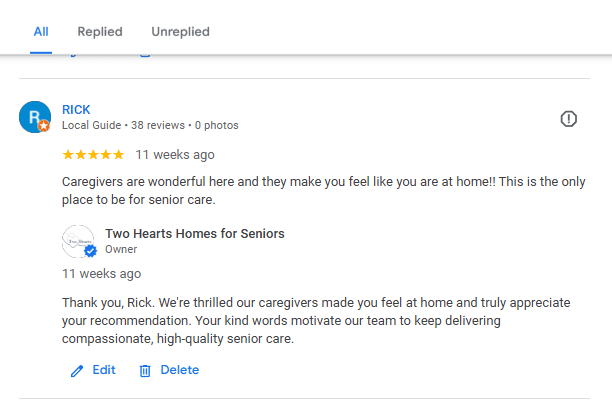
The stories in this article come from real families — some quoted from public reviews, some from conversations with our team, all reflecting what happens when a person lands in a place that fits.
We’d love to show you Two Hearts in person. Walk through the home. Meet the team. See the rooms, smell the kitchen, maybe meet Louie. And then make whatever decision is right for your family — with real information, not just imagination.
Take a Virtual Tour from Home →
We have homes in Lowell and Crown Point, Indiana, serving families throughout Northwest Indiana including Merrillville, Valparaiso, Munster, Schererville, Dyer, St. John, Highland, Griffith, and Portage.
You Might Also Find These Helpful
- Why Indiana Families Are Choosing Small Residential Homes Over Large Campuses →
- What to Pack When Moving Into Assisted Living →
Two Hearts Homes for Seniors is a nurse-owned, family-operated residential assisted living community with locations in Lowell and Crown Point, Indiana. We care for 16 residents at a time — so every person who lives here is genuinely known, not just cared for.